


What Size Generator do You Need?
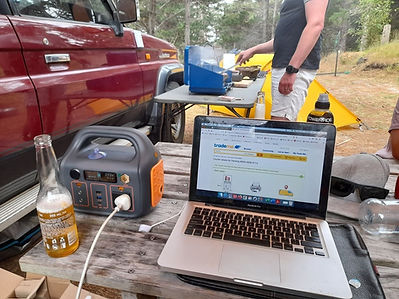
See below for guidance on what size generator you need. We have sizes from as small as 80wh up to 3000wh. Let us know your needs and we can help figure out the right solar power station for you. Our family, friends and we all use these as you can see in the images below. We have learned a fair bit along the way and can help you out.



Some more information for you...
A solar generator can refer to the whole solar system. Here are the two main parts of such a system.
1. The solar panels – which collect the solar energy from direct sunlight.
2. The power station – which stores the electrical power converted by the solar panels.
How Power Stations Are Sized
Power stations are typically sized in watts (W). This is a measure of power that’s used to calculate the rate of energy transfer. But what you really need to know is that the greater watts a power station has, the more power it can provide you in a single charge.
That being said, there are different watt measurements to pay attention to when deciding on a power station.
Continuous Power
The first measurement is usually called continuous power. This is the amount of power that a power station can provide consistently.
Peak Power
The second measurement is usually called peak power. This is the maximum amount of power that a power station can provide in a short burst.
Continuous Power vs. Peak Power (An Example)
Here’s an example. Think of when you turn on your air conditioner. It needs a quick burst of power to get started. That’s peak power. But the amount of power needed to continuously run the AC unit is generally lower. That’s continuous power.
Some appliances, such as refrigerators, need a burst of 3-7 times their normal power needs to get started. Keep in mind, your power station needs to be able to accommodate this peak power requirement to run the appliance. So, if you are looking for a solar generator to run a refrigerator, simply meeting the continuous power requirements won’t be enough.
Continuous power will likely be the more impactful number for you to think about. It’s what tells you how much power you will get from a single charge of your power station under normal conditions.
How to Calculate Your Optimal Power Station Capacity in 4 Steps
PlugMe sells power stations to meet a wide variety of power consumption needs. Our products range from 80Wh of capacity to as high as 3000Wh of capacity and we are working on larger ones at the moment.
How Many Watts Do I Need in a Solar Generator’s Power Station?
To figure out which PlugMe product offers the right power capabilities for you, you’ll need to perform the following calculations:
Step 1: Select What You Want to Power With Your Power Station and For How Long.
The first part of picking the right power station for your needs is understanding what those needs are. This means selecting the specific devices that you want to power with your solar generator and setting a rough estimation of how long you’d like for its power station to provide that power.
Tip: Be sure to only pick devices that you can plug into your Power Station. For example, things like water heaters are often hardwired into your home. So, the chances are you wouldn’t be able to power one with a power station. (Unless you also hardwire that device to your home.)
Here are some common devices that people power with solar generators:
-
Laptops and PCs
-
Phone chargers
-
Kitchen appliances
-
Hairdryers
-
Air conditioners
-
Video game systems
Step 2: Find Out How Much Energy Each of Your Selections Uses
Once you know what you want to power, it’s time to figure out how much energy you need to do so.
The starting point towards calculating this is finding out how many watts your devices need to run. This number is often listed somewhere on the device itself. But if you only see a measurement for amps, you can multiply that number by the item’s voltage to convert it into watts.
Shown here:
watts = amps x voltage
Next, you need to pick how many hours you want to be able to use each of your devices. Then, multiply the number of hours that you’ve selected by the watts of each item. This will give you the total watt-hours you require to be able to power each device.
Shown here:
total estimated use (in hours) x appliance wattage
= watt-hours (wh)
Here’s an example:
You want to power two 60-watt lightbulbs for two hours each. To find the total amount of watt-hours of power you need:
-
Get the total hours: Multiply 2 hours of power by 2 light bulbs. (2 x 2) = 4
-
Get the wattage: Each light bulb is 60 watts. (60)
-
Multiply them together to calculate the total watt-hours. (4 x 60) = 240
Then, divide your answer by 0.85 to account for a constant energy consumption rate of 85% when the device is in charge.
-
240 watt-hours / 0.85 = 282.4 watt-hours
This results, in you needing a power station that can provide at least approximately 283 watt-hours to meet your goal of being able to power two 60 watt lightbulbs for 2 hours each.
Step 3: Add All Of Your Watt-Hour Answers Together
You need to perform the calculation shown in the previous step for each item you want to power with your PlugMe Solar Generator. Then, simply add all of the answers together to get the total amount of watt-hours that you need the power station to provide and reach the goals you have for it.
For example, let’s say you need 400 watt-hours to power your lights, 300 to charge your phone, and 300 to charge your laptop. Your total watt-hour requirement would be 1,000 (400 + 300 + 300).
Step 4: Determine the Watt-Hours of the Power Station You Want
At this stage, you have all the information that you need to pick the right portable power station.
Simply take your answer from Step 3 and compare it to the wattage offered by each power station that you look at. Just make sure that you pick a power station that has a higher wattage than your total watt-hour requirement calculated in Step 3.


